Construction RV Anna Weber-van Bosse
In November 2022, the NWO-I Foundation Board approved the definitive grant of the contract for the construction of RV Anna Weber-van Bosse to Spanish shipbuilder Astilleros Armon. After years of preparations, construction startend in October 2023 on this innovative, sustainable and unique vessel to replace the 35-year-old RV Pelagia. She was launched a year later, in October 2024 and was transferred to NIOZ during the sea trials on 6 February 2026 in Vigo. And as a last step, the vessel was christened by Queen Maxima on 12 March 2026.
Milestones
Contract signing
On 16 December 2022, the contract for the construction of the new Dutch ocean-going research vessel, the RV Anna Weber-van Bosse, was signed on Texel. NWO approved the definitive grant of the contract for this project to Spanish shipbuilder Astilleros Armon, which emerged as the best option from the obligatory European Tender. Armon is world leader in the design and fabrication of Research Vessels.

Representatives of NWO (Marcel Levi), NIOZ (Han Dolman) and Spanish shipbuilder Astilleros Armon (Laudelino Alperi Baragano) sign the contract. (Photo: NIOZ/Evalien Weterings)
Start construction
On 11 October 2023, the festive start of construction of the new ocean-going research vessel the RV Anna Weber-van Bosse took place at the Spanish shipyard Astilleros Armon in Vigo. The traditional coin 'for good luck' was welded onto the first steel keel plates by captain Hein Oenema and Gert-Jan Reichart, head of NIOZ's Ocean Research Department.
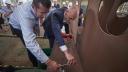
Welding of the coin on the first steel plate by Henk Oenema (Captain RV Pelagia) and Gert-Jan Reichart (Head of Ocean Research and scientific coordinator for this project). (Photo: Chou Pesquiera)
Launch
On 31 October 2024 the RV Anna Weber-van Bosse was launched. During the first year of construction, the almost 80 meter-long hull was built in the hall at Armon Shipyards' yard to roughly eight stories. But the entire ship would not fit in the assembly hall of the shipyard, which is why, among other things, the bridge is built on top of it outside the hall. During the second year of construction, the entire interior has been fitted out with all technical facilities and research facilities. This is done while the ship is in the water.
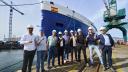
Project team celebration the successful launch in the water. (Photo: Chou Pesqueira)
Transfer
During a series of sea trials aboard RV Anna Weber-van Bosse, the official transfer of the ship was signed today. Han Dolman, director of NIOZ, and Laudelino Alperi Baragano director and co-owner of shipyard Astilleros ARMON signed this important document. With this, NIOZ became the owner AND responsible for the ship.
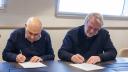
Han Dolman, director of NIOZ and Laudelino Alperi Baragano director and co-owner of Astilleros ARMON, S.A. (Photo: Armon)
Christening
On Thursday 12 March 2026, Queen Máxima christened RV Anna Weber-van Bosse during a festive event at the NIOZ harbour on the Texel.Hereby marking the completion of our brand-new research fleet. The nearly 80-metre vessel of the Royal Netherlands Institute for Sea Research (NIOZ) is considered by researchers to be one of the most advanced research vessels in the world and will enable a major step forward in research into climate change, ocean circulation and biodiversity.

Queen Máxima with NIOZ director Han Dolman (credit: Evalien Weterings)
Improvements RV Anna Weber - van Bosse compared to RV Pelagia
- The vessel will be able to accommodate double the number of researchers on board, which makes it possible for multiple teams to work simultaneously.
- A large aft deck offers space for more modular research containers to conduct experiments at sea.
- The ice class will facilitate research closer to the edge of the ice, which is extremely urgent to study melting ice caps.
- The vessel will be equipped with DP2 to facilitate dynamic positioning with a high degree of precision, which is a requirement for working in windmill parks to study the ecology there.
- The drop keel makes it possible to use equipment for observations deep in the water column, without obstruction from the boundary layer.
- The design specifically addresses the use of autonomous devices (drones, Autonomous Underwater Vehicles) or Remotely Operated Vehicles (ROV).
- The A-frame on the aft deck is taller and stronger, so the German autonomous drilling system MEBO can be operated from the Anna Weber-van Bosse to obtain long core samples from the deep seas.
- In addition to a medium to deep water multibeam echo sounder, also present on the Pelagia, a high-resolution shallow water multibeam system has been installed, allowing more accurate measurements in shallow waters.